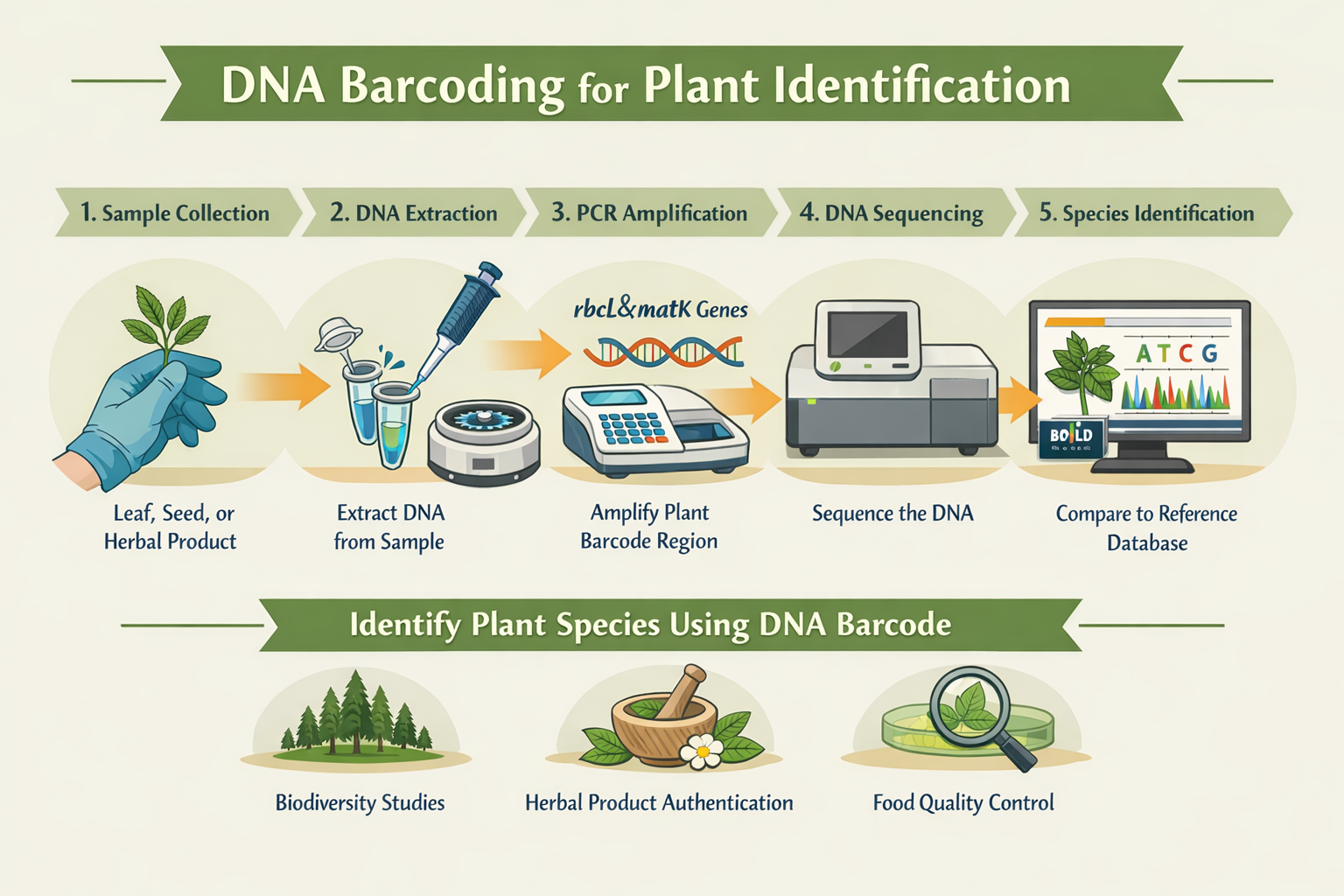
Customized DNA Barcoding Test Framework for Agarwood (Aquilaria spp.), tailored for plantation verification, research, and high-value trade authentication.
Purpose
Agarwood DNA barcoding is used to:
- Verify true Aquilaria species
- Distinguish Aquilaria malaccensis from other Aquilaria species
- Detect substitution or adulteration
- Support CITES compliance
- Authenticate planting materials (seedlings, tissue culture plantlets)
- Protect premium agarwood investment assets
Target Species of Interest
Common agarwood-producing species:
- Aquilaria malaccensis
- Aquilaria cumingiana
- Aquilaria filaria
Misidentification risk: Seedlings and young trees are morphologically similar — DNA testing ensures species purity.
Recommended Barcode Markers for Agarwood
Because agarwood species are closely related, a multi-locus approach is recommended.
Primary Markers:
- ITS (Internal Transcribed Spacer) – High species resolution
- matK – Chloroplast gene, useful for species-level ID
- rbcL – General plant confirmation
Best practice: Use ITS + matK combination for accurate Aquilaria differentiation.
Step-by-Step Agarwood DNA Barcoding Workflow
1. Sample Collection
Suitable samples:
- Fresh leaf tissue (preferred)
- Cambium tissue
- Seedling leaf for nursery validation
- Wood shavings (more difficult but possible)
Avoid: Highly resin-saturated heartwood (low DNA yield)
2. DNA Extraction
Agarwood leaves contain:
- Polyphenols
- Secondary metabolites
Recommended method:
- Modified CTAB extraction with PVP (to remove polyphenols)
- Commercial plant DNA kits with inhibitor removal columns
Quality check:
- Nanodrop purity ratio (A260/A280 ≈ 1.8)
- Gel electrophoresis for DNA integrity
3. PCR Amplification
Target genes:
- ITS (~650 bp)
- matK (~800 bp)
PCR Conditions:
- Standard 35 cycles
- Annealing temperature optimized per primer set
Verification:
- 1% agarose gel
- Clear single band confirms amplification
4. DNA Sequencing
- Purify PCR product
- Perform Sanger sequencing
- Analyze chromatograms for clean peaks
5. Species Identification
Sequence comparison using:
- Barcode of Life Data Systems (BOLD)
- National Center for Biotechnology Information GenBank BLAST
Interpretation:
- ≥99% match = strong species confirmation
- 97–98% = possible closely related species
- <97% = further investigation required
Applications in Agarwood Industry
1. Nursery Certification
Verify:
- True A. malaccensis elite plantlets
- No species mixing in plantation batches
- Tissue culture authenticity
2. Investor Protection
For estate or fractional agri-investments:
- DNA certificate per planting batch
- Traceable molecular identity record
3. CITES & Export Compliance
A. malaccensis is listed under:
- Convention on International Trade in Endangered Species of Wild Fauna and Flora (CITES)
DNA barcoding helps:
- Support legal sourcing claims
- Provide scientific documentation for authorities
4. Research & Breeding Programs
- Genetic diversity mapping
- Selection of elite mother trees
- Hybrid detection
- Germplasm conservation
Challenges Specific to Agarwood
- Hybridization between Aquilaria species
- Incomplete reference sequences in databases
- Resin formation does not affect leaf DNA, but heartwood DNA is degraded
- Closely related species require multi-marker confirmation
Strategic Advantage for Agarwood Enterprises
Implementing DNA barcoding allows:
- Certified species authenticity
- Higher investor confidence
- Premium branding (“Genetically Verified Aquilaria”)
- Protection from substitution fraud
- Scientific positioning in global markets